
What “ready” means
MOE’s preschool framework, Nurturing Early Learners, describes what children should be able to do by the end of preschool. Its goals cover the whole child: to “share and play with others”, to “communicate their thoughts and feelings”, to be “curious and able to explore” and to be “comfortable and happy with themselves”. The framework asks parents to pay equal attention to a child’s cognitive and non-cognitive development.
The sections below follow that balance. The skills listed in them are what we look for as teachers. They are a guide, not an official checklist or an entry requirement.
Social and emotional skills
- Asking for help. Being able to say “I don’t understand” or “I need the toilet” to an adult they do not know well.
- Taking turns and sharing. Waiting, losing a game and trying again.
- Making a friend. Saying their name and asking, “Can I play with you?”
- Managing feelings. Naming a feeling instead of crying or hitting, with an adult’s help at first.
- Following instructions in a group. Listening when the teacher speaks to the whole class, not only to them.
Board games, playground time and play dates build these better than any worksheet.
Looking after themselves
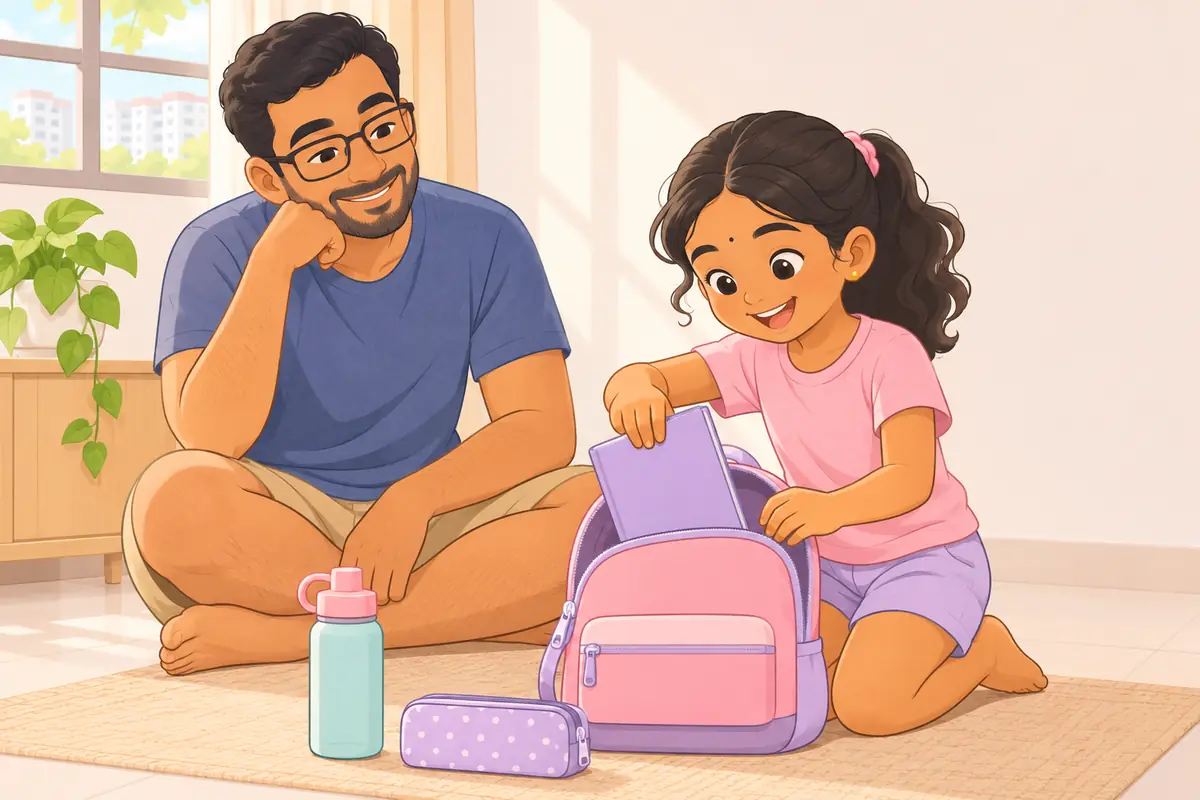
- Packing and carrying their own school bag.
- Buying food: choosing, paying and waiting for change. A few practice runs at a hawker centre or school canteen help a great deal.
- Using the toilet, washing hands and managing their uniform and shoes alone.
- Opening their own water bottle and lunch box, and finishing a meal in about twenty minutes.
- Knowing their full name, a parent’s phone number and who is fetching them.
Reading and language
The framework’s goals for English are to “listen for enjoyment and information”, “speak with confidence” and “read with enjoyment and understanding”. Enjoyment comes first in that list for a reason.
- Reading aloud. Read to your child every day, in English and in your child’s Mother Tongue. Ten minutes at bedtime is enough.
- Talking about the story. “What do you think happens next?” builds understanding.
- Letter sounds. Knowing the sounds letters make, and blending simple words such as “cat” and “ship”, gives a child a way into new words.
- Common words. Recognising everyday words such as “the” and “is”, and their own name.
- Writing. Holding a pencil comfortably and writing their name. Drawing, cutting and playing with play dough strengthen the hand.
Numeracy
The framework’s numeracy goals are for children to “develop counting skills and number sense”, to “understand relationships and patterns” and to “understand basic shapes and spatial concepts”. In everyday terms:
- Counting real things. Steps, grapes, the plates for dinner. Counting objects matters more than reciting numbers.
- More, fewer, the same. “Who has more?” and “How many more do we need?”
- Putting together and taking away with objects, before any written sums.
- Patterns and shapes. Spotting them on floor tiles, clothes and buildings.
- Money and time in daily life. Handling coins and knowing what happens in the morning, afternoon and night.
A gentle plan for the K2 year
| When | What to focus on |
|---|---|
| First half of K2 | Daily reading aloud, counting in everyday life, one household job that is fully theirs |
| Second half of K2 | Buying food alone, packing a bag, sitting at a table for a few minutes each day to draw, write or do a puzzle |
| November and December | Attending the school’s orientation, practising the morning routine and the journey, moving to an earlier bedtime |
This plan is our own suggestion. Go at your child’s pace, and leave plenty of time to play.
The first weeks of Primary 1
MOE’s guidance on the move to primary school names five changes a child faces: a new environment, a new routine and timetable, new relationships, new rules, and a new way of getting help in school. It suggests visiting the school together, talking through what happens each day, showing your child how to pack their bag for the day’s lessons, and assuring them that teachers will help.
Expect tiredness, and some tears, in the first month. That is a child adjusting, not a child failing. A calm goodbye and a listening ear after school do more than extra practice.
What we would say to a worried parent
- Children start at different points, and teachers expect that.
- Confidence is worth protecting. A child who believes “I can learn this” catches up. A child who has been drilled until they dread books may stop wanting to learn.
- Character counts from the first day. The framework’s core values are respect, responsibility, care and honesty. A child who is kind and tries hard is ready in the way that lasts.
Sources: MOE, Nurturing Early Learners Framework; MOE, Transition from preschool to primary school. Checked on 25 November 2026. Rules and dates can change, so please check the official page for your child’s year.
Questions parents ask
Does my child need to read before Primary 1?
MOE’s preschool framework aims for children to read with enjoyment and understanding; the pages we checked do not set a reading level for entry to Primary 1. Children start at different points. Knowing letter sounds and enjoying books give a child a comfortable start.
What should my child know before Primary 1?
From our experience in class: asking for help, taking turns, looking after their own belongings, buying food, enjoying books, knowing letter sounds, counting real objects and comparing more and fewer. These are suggestions, not an official checklist.
Does my child need a Primary 1 preparation class?
Not every child does. Much of what matters can be built at home through daily routines, reading together and play. A class can help where a child needs more practice with letter sounds, numbers or working in a group, or where parents would like guidance.
Related at Next Level Education: Preschool programmes · Phonics classes · Preschool numeracy