
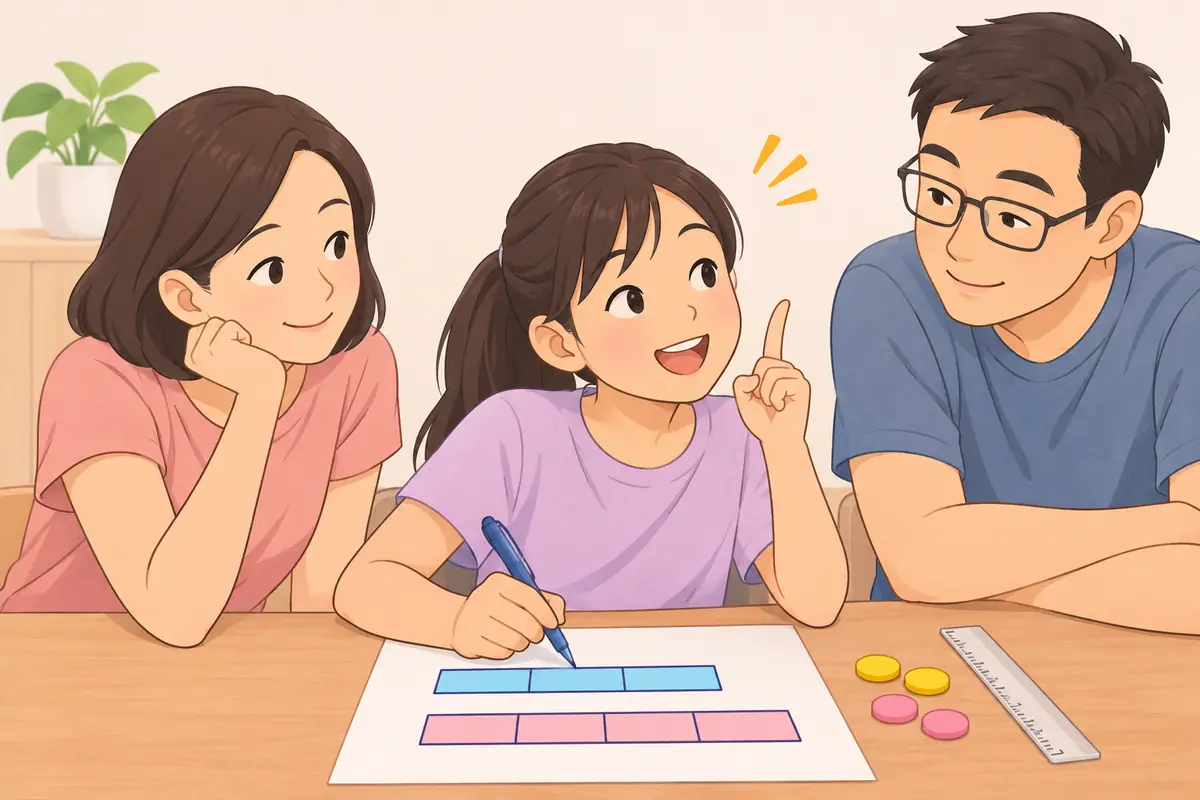
What MOE means by heuristics
MOE’s primary mathematics syllabus describes general problem-solving strategies, “Pólya’s 4 steps to problem solving and the use of heuristics”, as important in helping pupils tackle non-routine tasks systematically. The four steps come from the mathematician George Pólya:
- Understand the problem. What is given? What is being asked?
- Make a plan. Which strategy could work here?
- Carry out the plan. Work step by step and show the working.
- Look back. Does the answer make sense? Does it answer the question?
Heuristics commonly taught in primary school
The list below shows the heuristics that schools and teachers commonly use. It is not an official checklist, and your child’s school may use slightly different names.
| Heuristic | A small example |
|---|---|
| Draw a model | Ali has 3 times as many stickers as Ben. Together they have 48. Four equal units make 48, so one unit is 12. Ali has 36. |
| Work backwards | Mei spent half her money on a book, then $4 on a drink, and had $6 left. $6 + $4 = $10, and $10 × 2 = $20, so she had $20 at first. |
| Make a supposition | Some chickens and cows, 10 animals in all, have 28 legs. Suppose all are chickens: 20 legs. The extra 8 legs come from cows, 2 extra each, so there are 4 cows and 6 chickens. |
| Before and after | Sam and Tim had the same amount of money. After Sam spent $30, Tim had 3 times as much as Sam. The difference of 2 units is $30, so one unit is $15. Each had $45 at first. |
| Make a systematic list | How many 2-digit numbers can be made from 1, 2 and 3 without repeating a digit? 12, 13, 21, 23, 31, 32. There are 6. |
| Guess and check | Two whole numbers add up to 15 and multiply to 56. Try 6 and 9 (54), then 7 and 8 (56). The numbers are 7 and 8. |
| Look for a pattern | 2, 5, 8, 11 ... Each number is 3 more than the one before, so the next is 14. |
The PSLE Mathematics paper
| Paper | Questions | Marks | Time | Calculator |
|---|---|---|---|---|
| Paper 1 | 18 multiple-choice and 12 short-answer | 50 | 1 h 10 min | Not allowed |
| Paper 2 | 5 short-answer and 10 structured or long-answer | 50 | 1 h 20 min | Allowed |
This is the format from the 2026 examination. SEAB’s format also explains why working matters: in structured and long-answer questions the method must be shown clearly, and in a one-part short-answer question a correct method can earn 1 of the 2 marks even when the final answer is wrong.
How to help without taking over
- Ask before you tell. “What is the question asking?” and “What do you already know?” are often enough to get a child moving.
- Let your child draw. A rough model or diagram is thinking made visible. It does not have to be neat.
- Praise the method. “I like how you checked your answer” does more good than “You are so smart”.
- Allow some struggle. A few minutes of being stuck is where the learning happens. If tears are close, stop and return to it tomorrow.
- It is fine not to know. Saying “I’m not sure, let’s work it out together” shows your child that not knowing is where everyone starts.
What matters more than the method
MOE’s mathematics framework places attitudes beside skills: belief, appreciation, confidence, motivation, interest and perseverance. A child who believes a hard problem is worth another try will go further than one who has memorised ten methods but gives up at the first unfamiliar question. Protecting that belief is the most useful thing a parent can do.
Sources: MOE, 2021 Primary Mathematics syllabus; SEAB, PSLE Mathematics syllabus 0008. Checked on 25 November 2026. Rules and formats can change, so please check the official page for your child’s year.
Questions parents ask
What are heuristics in primary school maths?
Heuristics are general problem-solving strategies, such as drawing a model, working backwards or making a systematic list, that help a child get started on an unfamiliar problem. MOE’s syllabus names the use of heuristics alongside Pólya’s four steps to problem solving.
Can my child use a calculator in PSLE Maths?
In Paper 2 only. SEAB’s format states that calculators are not allowed in Paper 1 and are allowed in Paper 2.
Does my child lose all the marks if the final answer is wrong?
Not always. SEAB’s format states that for a one-part short-answer question, 1 mark is awarded for a correct method when the answer is incorrect. Structured and long-answer questions require the method to be shown clearly.
Related at Next Level Education: Primary Maths and Heuristics · PSLE Maths tuition · PSLE Maths Crash Course